
The Return of Initiation
How Modern Storytelling Flattened the Hero’s Journey

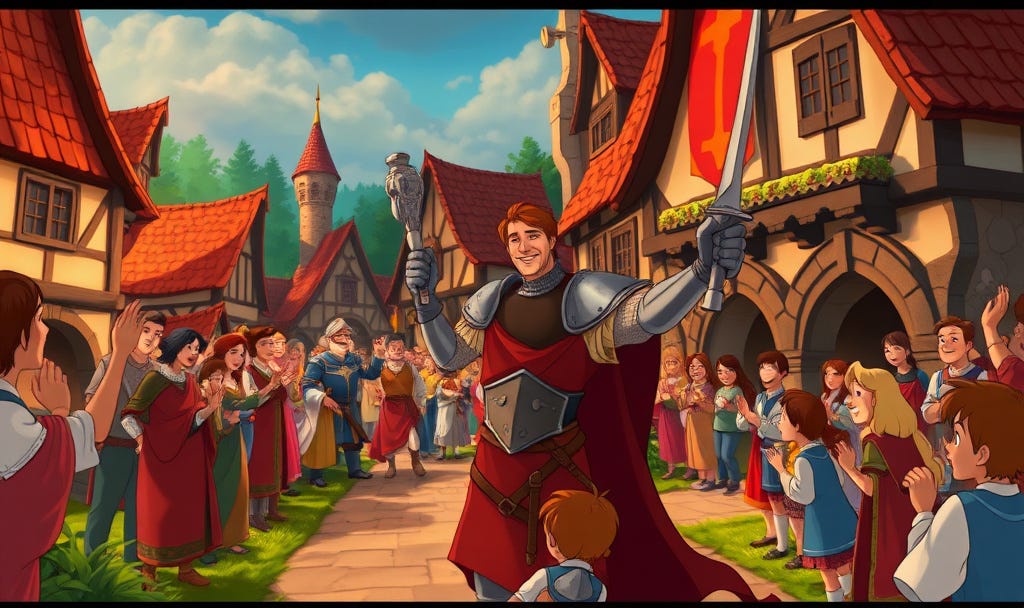
In each of the following stories, you will see a prince, a maiden, and a dragon. In each, the dragon seizes the maiden and the prince must defeat the dragon and save the maiden. But each story is fundamentally different.
A young prince is sent to rescue his beloved from a dragon that has laid waste to the countryside. He is untested and afraid. The beast wounds him, nearly kills him, and burns away his arrogance. Through sacrifice and hard-won skill, he slays it. He returns scarred but steadied, and his father names him heir not because he won, but because he has been forged.
A young prince is told he must rescue a princess from a dragon. He sees through the ritual. The kingdom is corrupt, the crown hollow, the pageantry false. He refuses to participate in a system that manufactures phony monsters. He wanders instead, narrating the hypocrisy of castles and crowns. The dragon remains. The princess’s fate is unknown. The prince remains unchanged.
A young prince is pressured to rescue a princess from a dragon. He begins to suspect the quest is less about danger than about expectation. The dragon, he discovers, is an external symbol of his repressed self. Instead of slaying it, he rejects the script written for him. He leaves the kingdom to find who he truly is. (And probably, the princess and dragon open a new-age crystal shop.)
A young prince has always been the kingdom’s finest warrior. When a dragon captures his beloved, he tracks it without hesitation, displaying superior skill at every turn. The beast is formidable but ultimately confirms his greatness. He slays it without lasting cost and returns triumphant, universally recognized as what he always was.
For most of human storytelling history, ordeal has been formative for heroes. The hero did not merely defeat danger; he crossed a threshold. Something in him died. Something else took its place. He returned narrower, heavier, responsible, initiated. The journey transformed the boy into the man.
In the middle of the twentieth century, that architecture began to shift for reasons that were not trivial. The young man who stands at the edge of adulthood in The Catcher in the Rye does not slay a dragon. He refuses to enter the castle at all. He sees corruption, hypocrisy, phoniness. He narrates it with clarity. And he stops there.
He is not punished for refusal. He is understood by the writer and by generations of readers.
This shift in storytelling is visible in the entire contemporary world of arts. What happened to initiation in the decades after the Second World War that caused such a change in how we view the Hero’s Journey? How did the erosion of the story reshape the kind of heroes we produce – and the kind of adults we expect to become?
The First Tale
A young prince is sent to rescue his beloved from a dragon that has laid waste to the countryside. He is untested and afraid. The beast wounds him, nearly kills him, and burns away his arrogance. Through sacrifice and hard-won skill, he slays it. He returns scarred but steadied, and his father names him heir not because he won, but because he has been forged.
For most of human history, this story was instruction, not entertainment. It was meant to show a young audience what it really was to be a man. The dragon mattered. The princess mattered. But what mattered most was what happened to the prince.
He began insufficient.
He faced something greater than himself.
He was wounded.
He endured.
He returned altered.
And crucially, he accepted responsibility.
Initiation is narrowing, not victory. When the hero sets out, the world is filled with possibilities. Each choice he makes on his journey cuts off some of those possibilities. The journey is the acceptance of limits, obligation, and weight after ordeal. At the end, the young man does not simply defeat danger; he crosses a threshold. Something in him dies – illusion, arrogance, boyhood – and something more durable replaces it.
In the classic heroic arc, the world does not rearrange itself around the protagonist. The protagonist is reshaped by fire to meet the world as it is. Authority precedes him. Hierarchy exists before he enters it. The kingdom does not justify itself to the prince; he proves himself worthy to bear its burden.
This ancient architecture governed epics, myths, frontier narratives, war stories, and domestic fiction. In The Odyssey, suffering precedes restoration. In The Lord of the Rings, the ring is destroyed, but Frodo does not return untouched. He cannot. The ordeal has marked him permanently. Luke Skywalker loses his family and his home. Han Solo becomes more hunted than ever.
Initiation was legible because culture in the real world provided containers for it. Marriage narrowed possibility; cleave unto one woman, and you are forbidden to enter into romantic or sexual relationships with other women. Apprenticeship required submission. Military service demanded hierarchy. Religious rites were simply a way to formalize transition and ensure the community observed it. A boy became a man not through self-declaration but through tested responsibility.
The pattern was not sentimental. Authority could be flawed. Kings could fail. Fathers could be unjust. But the structure itself was intelligible and as perfect as this world gets: maturity required asymmetry. The young submitted to something older. The self was not assumed complete at the outset.
This matters because after the Second World War, that narrative grammar began to shift. Not all at once. Not everywhere. And not without cause.
The horrors of industrialized war, heartlessness of bureaucratic expansion, and weight of mass ideological manipulation eroded trust in institutions that once were formative for young people. Psychological language rose as religious language receded. Authority no longer appeared self-evidently legitimate. Submission felt less like formation and more like risk.
Alienation was not invented in this period, but it was experienced as never before. And it lingered, whereas it once was transient.
As institutional trust thinned, so did the willingness to narrate initiation as virtuous. Suddenly, the great old patterns themselves seemed corrupted and damaged. If those structures are corrupt, then submission to them is foolish. If authority is hollow, then obedience is coercive. If suffering lacks a transcendent frame, it feels like damage, not formation. The fires that once forged men’s souls became a torture chamber that only a fool would submit himself to.
Gradually, stories began to shift. The dragon remained. The castle remained. But the hero’s relationship to responsibility began to change.
To see that change clearly, we return to a young man standing at the edge of adulthood in The Catcher in the Rye.
He does not slay the dragon.
He refuses the castle.
And he is understood.
The Hero’s Journey, Properly Understood (Campbell, Not the Cartoon)
Joseph Campbell’s “Hero’s Journey” gets flattened in pop culture into a travel itinerary: call, quest, fight, win. That isn’t the point; it never was, though men are bound to be in motion. The Hero’s Journey is about initiation: the hero crosses a threshold, suffers a kind of death, and returns to the regular world bound to responsibility.
A clean way to test whether a story is using the real structure is simple: does the ordeal permanently narrow the protagonist’s life? If not, you are watching spectacle, not initiation. The Hero’s Journey is required to narrow life choices.
To keep this concrete, I’m going to track each step against Star Wars: Episode IV – A New Hope, because most people have seen it and it is almost embarrassingly faithful to the pattern.
1) The Ordinary World: The hero begins unformed. Life is small. Desire is bigger than capacity. Luke is a farm boy on Tatooine, restless, untested.
2) The Call to Adventure: A disruption summons the hero into a larger conflict. The call comes from outside. Leia’s message arrives via R2-D2.
3) Refusal of the Call: The hero hesitates because he correctly senses the cost. Luke initially says he can’t go; he has obligations at home.
4) Meeting the Mentor: An older figure offers training, tools, and a higher frame. The mentor does not validate; he forms. Obi-Wan introduces the Force and hands Luke the saber.
5) Crossing the First Threshold: The hero leaves the old life. The story closes the door behind him. After the murder of his aunt and uncle, Luke cannot go back.
6) Tests, Allies, Enemies: The hero meets resistance and begins learning under pressure. Cantina danger, stormtroopers, Han and Chewie, the first real fights.
7) Approach to the Inmost Cave: The hero moves toward the center of danger. Stakes sharpen. The Death Star becomes the focus; rescue turns into confrontation with the regime’s heart.
8) The Ordeal: A symbolic death occurs – literal or relational – forcing the hero into a new level of being. Obi-Wan dies. Luke loses the safety of the guide.
9) Reward (Seizing the Sword): The hero gains something real – not just a prize, but increased capacity or clarity. They escape with Leia and the plans. Luke has tasted the Force under fire.
10)The Road Back: The hero returns toward the ordinary world, but is now pursued. The conflict follows him home. The Death Star tracks them to Yavin; there’s no return to “normal.”
11)Resurrection: The final test – the hero must act as the new self, not the old self. Luke turns off the targeting computer. He commits fully to the Force and the mission.
12)Return with the Elixir: The hero brings something back that restores life – and he returns changed, narrowed, responsible. The Rebellion survives. Luke is publicly recognized, but more importantly, he is now bound to the cause.
If you want the shortest possible summary: Campbell’s structure, used overtly and deliberately by George Lucas in creating Star Wars, is a machine that turns a person into someone who can bear weight. It does this by imposing loss, forcing threshold-crossing, and demanding a return that includes responsibility.
That is exactly what goes missing when modern stories keep the hero’s competence intact, treat loss as optional or reversible, and make the world adjust to the protagonist’s self-concept instead of making the protagonist earn the right to shape the world, as is shown in the next section.
The Structure Begins to Fracture
A young prince is told he must rescue a princess from a dragon. He sees through the ritual. The kingdom is corrupt, the crown hollow, the pageantry false. He refuses to participate in a system that manufactures monsters. He wanders instead, narrating the hypocrisy of castles and crowns. The dragon remains. The prince remains unchanged.
With Campbell’s framework in view, the post-WWII shift becomes easy to see. The dragon did not disappear. Conflict did not disappear. Spectacle certainly did not disappear. What began to disappear were specific stages of formation.
Not all at once. Not in every genre. But steadily.
In the classic arc, hesitation – the famous Refusing the Call to Adventure – proves the hero’s unpreparedness. The call exposes fear that has not been outweighed by need. The refusal is temporary. Eventually, the story moves the hero across the threshold anyway.
In mid-century literature, refusal hardens and becomes an endpoint.
In The Catcher in the Rye, Holden Caulfield stands at the edge of adulthood. The dragon is Holden’s incumbent entry into adult society: work, responsibility, compromise, structure. He sees its hypocrisy clearly. His critique is often justified. But he does not cross the threshold.
And crucially, the narrative does not compel him to.
The refusal becomes a stable posture. The story ends with alienation intact. Campbell’s machine stalls at Step Three. That one story alone would not have altered a culture. But the posture spread more widely into literature and storytelling, eventually even gaining a catchphrase: Turn on, tune in, and drop out. It became a zeitgeist, not an anomaly.
In On the Road, the threshold is crossed physically but not structurally. The characters move constantly, but they do not submit to formation. There is experience, but no narrowing. Motion replaces maturation. The Call is answered, but not toward responsibility. It becomes escape.
The failed Call to Adventure is only one point at which the traditional story broke. The next fracture appears at the Ordeal.
In the classic structure, the Ordeal includes symbolic death. The mentor dies. Illusion dies. Safety dies. The hero cannot return unchanged.
In many postwar narratives, suffering becomes diagnostic rather than transformative. It reveals corruption. It exposes hypocrisy. It confirms the hero’s sensitivity. But it does not prune him. The Ordeal becomes evidence against the world instead of refinement of the self.
And a final breaking point: the Return with the Elixir thins out.
The hero may survive. He may even win. But he does not return bound to responsibility in the same way. Kingship becomes optional. Governance becomes suspect. Integration into structure feels like compromise.
This is the subtle inversion:
In the classic arc, the world tests the hero and shapes him.
In the mirror arc, the hero tests the world and indicts it.
Authority, once asymmetrical, must now justify itself constantly. The mentor figure weakens or disappears. The threshold becomes permeable. The Ordeal wounds but does not narrow. The Return becomes personal affirmation rather than public obligation.
Holden does not slay a dragon. He refuses the castle. Later protagonists slay dragons but decline the crown. Still later ones keep the crown but never change.
Each stage removes a piece of the machine.
By the late twentieth century, the Hero’s Journey still appears on the surface – there is a call, a quest, a climax – but its internal logic has shifted. The structure remains visible, but the transformation is gone.
To see what that produces, we move from alienation to escalation.
The Therapeutic Turn: When the Dragon Moves Inside
A young prince is pressured to rescue a princess from a dragon. He begins to suspect the quest is less about danger than about expectation. The dragon, he discovers, is an external symbol of his repressed self. Instead of slaying it, he rejects the script written for him. He leaves the kingdom to find who he truly is.
By the 1960s and 1970s, the fracture in the Hero’s Journey deepens. The refusal of the call has already gained moral prestige. Now the nature of the ordeal itself begins to change.
In Campbell’s structure, the Ordeal is an encounter with something objectively dangerous and resistant. The dragon is real. The world pushes back. The hero must adapt or die.
In the therapeutic turn, the dragon migrates inward. It is no longer primarily a threat to the kingdom; instead, it is a threat to the hero’s integrity. Conflict becomes symbolic of repression. The quest is reframed as expectation imposed by family, culture, or hierarchy. The threshold is entry into self-knowledge, not external danger. The mentor, if present at all, is often unmasked as complicit in the oppressive script.
The Ordeal still occurs, but its function shifts. Instead of burning away illusion, it reveals that the hero was miscast. Suffering does not narrow him toward responsibility; it justifies departure from structure.
The Return with the Elixir stage collapses almost entirely. There is no kingdom to restore. There is no father to affirm the burden of rule. The only “elixir” is authenticity.
You can see this shift clearly in films like Good Will Hunting. Will’s “dragon” is not a monster threatening society. It is his trauma and fear of intimacy. The ordeal does not bind him to institutional responsibility. It frees him from avoidance and sends him toward personal authenticity.
Or consider Dead Poets Society. Authority is suffocating, not formative. The mentor figure encourages self-expression against institutional rigidity. The dragon is conformity. The act of slaying it is rejecting imposed scripts.
More recently, Encanto internalizes conflict almost entirely. The danger is not an external threat but generational expectation and identity pressure. The “ordeal” reveals emotional truth. The resolution restores authenticity within the family structure, but responsibility is reframed as mutual affirmation. (And here we see shades of a later stage in this transformation of the Hero’s Journey: the heroine, rather than finding the elixir, turns out to have had the power in her all along.)
This shift does not arise in a vacuum. During the 60s, psychological language expanded, and trauma became a dominant interpretive lens. The training montage was swapped out for the psychiatrist’s couch. Authority is interrogated as potential harm. Religious cosmology thins, and with it the metaphysical justification for suffering as formative.
When the journey turns inward, symbolic death feels suspect. If the self is fundamentally valid, then pruning appears violent. If institutions are corrupt, then crossing the threshold looks like surrender to distortion.
So the dragon is reconceived.
It is no longer a creature that must be slain to protect the community. It is an internalized construct that must be understood, integrated, or transcended. The hero’s task is not to accept responsibility for the kingdom but to escape a misaligned identity.
Across these stories, Campbell’s stages remain visible:
There is a call.
There is an ordeal.
There is transformation.
But the transformation runs in a different direction. It is not from insufficiency to responsibility. It is from imposed identity to self-definition.
The Return with the Elixir becomes psychological integration.
The kingdom may remain intact. But the hero is not narrowed toward burden; he is liberated toward self-expression. The dragon has moved inside. The machine that once produced adults now produces autonomy.
From here, it is a short step to a different mutation altogether: stories in which the dragon is real again, but the hero no longer needs to change in order to defeat it.
The Escalation Era: When the Hero No Longer Needs the Fire
A young prince has always been the kingdom’s finest warrior. When a dragon captures his beloved, he tracks it without hesitation, displaying superior skill at every turn. The beast is formidable but ultimately confirms his greatness. He slays it without lasting cost and returns triumphant, universally recognized as what he always was.
If the therapeutic turn relocates the dragon, the escalation era restores it – but removes its power to reshape the hero. The monster is real again. The stakes are visible. However, the protagonist begins not weak, but sufficient.
In Top Gun: Maverick, Maverick is already elite. The central conflict tests him, but it does not fundamentally alter him. The narrative arc proves that his instincts were correct. Authority bends toward his judgment.
In The Matrix Resurrections, perhaps a better example, Neo’s journey is less about formation than about rediscovery. His power is latent, suppressed. The ordeal confirms identity rather than reshaping it.
The John Wick franchise offers perhaps the purest escalation model. Wick begins hyper-competent. Each sequel raises the stakes, expands the underworld, and intensifies spectacle. He is wounded physically but not transformed morally. The machine tests him; it does not forge him.
Even superhero cinema often follows this pattern. In Black Panther, T’Challa faces challenge, but his arc is primarily one of policy adjustment rather than existential reshaping. His kingship is affirmed; his core identity remains stable.
Campbell’s steps are still present on paper:
There is a call.
There are trials.
There is a climax.
There is a return.
But look closely at what is missing:
The hero does not begin insufficient.
The mentor does not fundamentally shape him.
The Ordeal proves rather than prunes.
The Resurrection is spectacle, not rebirth.
The Return confers recognition, not binding responsibility.
The dragon’s fire becomes confirmation.
The audience receives competence fantasy and recognition fantasy.
The hero crosses every threshold – and remains the same man.
The Elimination of Apprenticeship
When origin stories remove visible formation – not compress it, not imply it, but erase it – the myth, the story, ceases to ring true.
In Campbell’s structure, apprenticeship is not decorative. It is the mechanism by which insufficiency becomes responsibility. The mentor shapes. The hero fails. The ordeal burns away illusion. Skill is earned. Authority is achieved only after discipline and pain.
Apprenticeship is the phase that makes the Return binding. When you suffer for something, you take it seriously.
Consider again Star Wars: Episode IV: A New Hope. Luke trains. He hesitates. He loses Obi-Wan. He nearly dies in the trench. When he finally uses the Force, it is in submission to something larger than himself. When he stands at the medal ceremony, the applause matters less than the narrowing of his life. He now belongs to the Rebellion.
Or Rocky. Rocky bleeds. He trains in obscurity. He loses the first fight. The dignity he earns is inseparable from the cost he pays. When he wins in the sequel, the victory rests on visible forging.
Now compare several recent high-profile origin stories in which apprenticeship is functionally absent.
In Star Wars: The Force Awakens, Rey (infamously) pilots with ease, repairs complex machinery instantly, resists interrogation, summons the Force, and defeats a trained Sith with minimal instruction. There is little visible apprenticeship. Not only is she already skilled without work, she expects to be skilled. The ordeal only reveals her power; it does not forge it. No, the power was in her all along.
In Captain Marvel, Carol Danvers’ arc centers on removing inhibitors placed upon her. Her power is recovered, not earned through visible discipline or moral failure. Emotional integration is implied rather than costed.
In the live-action Mulan, innate chi replaces the slow training arc of the 1998 version. Competence precedes struggle. Revelation substitutes for formation.
Yes, this is the Girlboss stage of the disintegration of the Hero’s Journey. But while the stories of the earlier listed heroes at least explain where their skills came from – Maverick’s from long hours training to be a pilot, Wick’s from his previous career as an assassin – the Girlboss’s skills are hers from the beginning. Like Dorothy in The Wonderful Wizard of Oz, the power was hers all along.
These films are often defended as empowerment narratives. But empowerment without apprenticeship is fragile. Strength without visible forging feels unearned – not because women cannot be strong, but because human growth requires discipline, failure, and time.
This is not unique to female protagonists. Male origin stories that skip apprenticeship are equally thin. When heroes begin already competent, morally clarified, and strategically superior, the journey short-circuits. The Ordeal stage proves greatness instead of pruning it, and possibilities are never narrowed. The Resurrection becomes spectacle rather than rebirth.
We notice the Girlboss more readily because the baseline expectation for female public power narratives is newer and more politically charged. Visible vulnerability is treated as risky, so creators avoid it. Studios hesitate to depict heroines as deeply insufficient or dependent on mentors for fear of regression.
But when apprenticeship disappears entirely, whether the hero is male or female, the story loses credibility – and credibility is what makes power meaningful.
Earlier blockbuster heroes – almost all male – were allowed prolonged apprenticeship, humiliation, and visible moral reckoning before becoming powerful. Some recent female-led origin stories compress or eliminate that phase. The result is not stronger heroines but implausible ones.
The same flattening appears in male escalation arcs. Familiarity simply makes it harder to see.
Initiation requires visible insufficiency.
Visible insufficiency requires risk.
Without risk, the Return carries no weight.
When heroes do not suffer for their strength, they do not bind themselves to responsibility afterward. And without responsibility, the Hero’s Journey collapses into empty affirmation, Oprah-worthy but not worthy of a good story.
The Hollowing of the Return
If the Hero’s Journey has a fulcrum, it is the Return, not the dragon. In Campbell’s structure, the Return with the Elixir is the stage that binds the hero to responsibility. The quest is not complete when the monster falls. It is complete when the hero comes back altered and accepts the burden of his new role.
The Return means narrowing. While one possibility has been achieved, others have closed forever. The farm boy does not go back to moisture farming. The apprentice does not resume innocence. The warrior does not reclaim anonymity.
Something has died. Something else has been forged. And forging creates obligations, responsibilities.
In Star Wars: Episode IV: A New Hope, the medal ceremony is not the real ending, but rather a recognition of the hero’s success. Luke is permanently reoriented. He now belongs to the Rebellion, not his old farm and his murdered aunt and uncle. His life, in a real way, is no longer his own, but it is elevated from his childhood. Victory binds him.
In Rocky, the final bell, rather than crowning a champion, makes him accountable. Rocky has proven he can endure. The cost reshapes his identity. The sequel’s escalation rests on that forged foundation.
Now contrast these classic heroic arcs with contemporary arcs.
In the refusal pattern, there is no Return. Holden in The Catcher in the Rye does not reintegrate. He narrates his alienation and suspends his life instead, existing in a shadowland between child and adult. The threshold is never crossed, so he cannot be bound. His possibilities all exist, but they will never be fulfilled. He is, in a way, already dead because he has ceased to grow.
In the therapeutic pattern, the Return becomes self-clarification. The hero integrates emotionally but is not obligated structurally; some pathways are closed to him now, but he has no responsibility. The kingdom is secondary to the psyche.
In the immunized escalation pattern – the Girlboss – the Return becomes recognition. The hero is applauded, vindicated, affirmed. The world acknowledges what the hero already was. Responsibility feels like entitlement rather than burden. All those possibilities were illusory, but they also still seem to exist. This pattern is so unrealistic that audiences reject it. It has no gravity and ends with no obligation.
Campbell’s Return, the classic pattern, required the hero to bring something back to the community – wisdom, protection, order – and to submit to the consequences of having changed. The elixir was not self-esteem or self-knowledge or illusion. Rather, it was service to the community with the Hero’s new skills and abilities.
When apprenticeship disappears, the Return loses its gravity. When the Ordeal does not prune away possibilities, the Resurrection does not demand new behavior. When the hero is never truly insufficient, the victory carries no cost or burden.
The flattening of initiation in post-WWII storytelling has produced protagonists who win without being forged and cultures that expect recognition without responsibility.
This is a structural change, and it reflects something structural that has changed in our culture.
If stories repeatedly end at validation rather than obligation, audiences internalize a subtle expectation: achievement should confirm or affirm identity, not constrain it. Triumph should expand options, not narrow them. Success should bring acclaim, not duty.
The dragon falls. The prince is cheered. The crown sits lightly. And the kingdom waits for someone who understands that wearing that crown should and will hurt.
When the Return Disappears from Culture
Stories do not command behavior; rather, they shape expectation. When the Return with the Elixir thins in narrative, responsibility thins in imagination.
If protagonists repeatedly win without visible apprenticeship, suffer without being pruned, triumph without narrowing, and receive recognition without binding obligation, audiences begin to absorb certain quiet premises: power affirms rather than binds; victory expands rather than constrains. This is the opposite of what stories used to do.
Children’s play reflects boundless possibilities, and in a healthy society, as children mature, those possibilities narrow into a career or life trajectory. The child understands, on adulthood, that he is never going to be a pirate captain, or Robin Hood, or a Jedi Knight, but that he can be a damn good doctor, father, and community leader. But today, our children refuse maturation, preferring to keep all those imaginary paths open rather than commit to a single path with its commensurate responsibilities and obligations. They miss out on the joy of completion and a full life.
This is what our stories now reflect.
The fragility of the Return becomes clearer when we look backward. In the ancient Sumerian myth of Inanna and her lover Dumuzid, the goddess descends into the underworld. At each gate she is stripped of status, clothing, and power. She is judged, killed, and hung on a hook. Only after intervention is she restored – and even then, someone must take her place, undergoing the agonies of that hook. Dumuzid is chosen to descend in her stead for part of the year.
The descent is structured loss. Power is removed. Status is stripped. Death is literal within the story’s logic. And return requires exchange and obligation.
Even in one of our oldest surviving myths, initiation is inseparable from stripping and consequence. There is no ascent without descent. There is no return without cost.
This pattern appears across civilizations: descent precedes authority. Death precedes restoration. Something must be surrendered so something durable can be gained.
Modern storytelling has not eliminated descent entirely. It has made it reversible, symbolic without consequence, or brief enough to avoid true stripping. The hero may enter darkness, but rarely is he or she hung on the hook. Rarely does return demand substitution or narrowing.
Even language reflects the discomfort. We rarely say, “He died.” We soften it: “He passed.” Finality is gentled. If literal death has become linguistically unbearable, symbolic death becomes narratively intolerable.
Yet initiation requires symbolic death. Something must end so something stronger can begin. Without that storytelling grammar, loss reads only as injury rather than formation.
In a world thick with transcendent meaning, suffering is a refinement, as ore is refined before forging. In a flattened cosmos, suffering is just – damage. Without a metaphysical frame that shows pruning away those possibilities has a purpose, submission to maturity feels humiliating rather than developmental. Responsibility appears imposed rather than chosen.
The drift toward affirmation rather than reformation follows naturally. Icons must not be stripped for long. Heroes must not be left hanging. The Return becomes applause.
Applause, however, is far lighter than duty.
Why Humans Cannot Live on Affirmation Alone
Humans are shaped by story. Telling a story should never be taken lightly. It is a transcendent occupation.
In The Storytelling Animal, Jonathan Gottschall argues that narrative is not cultural garnish, but rather cognitive equipment. The human mind constantly constructs simulations – daydreams, imagined futures, remembered pasts. Story is rehearsal space. It allows us to model danger, loyalty, betrayal, ambition, sacrifice, and consequence before encountering them in lived experience.
If that rehearsal space removes gravity – if actions have no irreversible cost, if power arrives without apprenticeship, if victory expands rather than narrows – then the simulation ceases to resemble reality.
It may still entertain and comfort. But it stops orienting. It is just entertainment, not something that builds humans into adults.
Joseph Campbell, in The Hero with a Thousand Faces, does not treat the Hero’s Journey as a formula for box-office success. He treats it as a cross-cultural pattern of maturation. The Call, the Ordeal, the Resurrection, and the Return encode a structure of transformation. The hero begins insufficient. He is stripped and tested, symbolically dies, and returns altered and bound.
That binding is crucial. The Return is not applause at all. It is obligation.
Across civilizations – Greek, Mesopotamian, Norse, Hindu, even Australian aborigine, remote from all other cultures – the descent precedes authority. Power is not self-generated. It is conferred through ordeal. The myth does not flatter the hero. It forges him or her.
When stories become dominated by affirmation and escalation, something subtle disappears: irreversible consequence.
Without irreversible consequence:
Choice loses weight.
Sacrifice loses cost.
Authority loses legitimacy.
Maturity loses definition.
Humans require gravity because we are finite. Our lives narrow whether we consent or not. Time constrains. Bodies fail. Relationships bind. Death ends.
A narrative grammar that omits narrowing cannot adequately prepare the human psyche for the narrowing that comes in real adult life. A story that avoids symbolic death cannot metabolize real loss.
Bubble-gum stories have their place. Levity is not corruption. Comedy is not decline. But no civilization can sustain itself on confection alone. At scale, stories perform a cognitive and moral function. They teach causality. They model responsibility. They integrate suffering into coherence.
If those functions thin, the culture does not stop suffering. It simply suffers without rehearsal.
That is what disappears when affirmation replaces initiation. Not excitement. Not spectacle.
Orientation. We simply lose our way through life. You know people who just drift. This is why: they never narrowed their possibilities, never suffered in a way that grew them up.
The Fifth Dragon
Before closing, one more story.
The young prince is called to rescue his beloved from a dragon. He trains long before he ever sees the beast. He fails in smaller battles and learns restraint. When at last he faces the dragon, he slays it, but not without wound. He returns not to applause alone, but to rule. He accepts the crown knowing it will cost him comfort, freedom, and perhaps his life. The kingdom celebrates. He kneels.
That is the old pattern.
The dragon is real. The wound is real. The return is binding.
This is not just nostalgia for a simpler age. The older myths were not sentimental. Prometheus is chained. Inanna is stripped and hung on a hook. The hero of The Hero with a Thousand Faces does not return enlarged; he returns obligated.
What distinguished those stories was not cruelty, but gravity. The old stories assumed that power must be paid for. They assumed that descent precedes authority. They assumed that responsibility narrows.
Modern audiences have grown accustomed to affirmation and escalation. Heroes are validated. Dragons are defeated. Crowns sit lightly. The return often means recognition rather than rule.
But the hunger for real, nourishing stories remains.
Humans do not stop needing orientation because spectacle is plentiful. We do not stop aging because identity is affirmed. We do not stop suffering because language softens death. Our lives narrow whether stories acknowledge it or not.
The flattening of initiation in postwar storytelling has produced protagonists who win without being forged, and cultures that expect recognition without responsibility.
Yet gravity does not disappear. It waits.
If storytellers reintroduce apprenticeship, visible insufficiency, and binding return, they restore rehearsal space. They allow descent without catastrophe. They give audiences a grammar sturdy enough to metabolize loss and authority alike.
If they do not, reality will supply the lesson.
The question is not whether dragons exist. Of course they exist.
It is whether we will once again write heroes who bleed, who triumph, who kneel.
Just saw your piece on AI on pjmedia. I see we both came to the same conclusion.
https://natewinchester.wordpress.com/2025/09/08/dont-fear-the-bot/
Originality is hard for the bot, easy for man. ;)