
Child of Glass
A short story

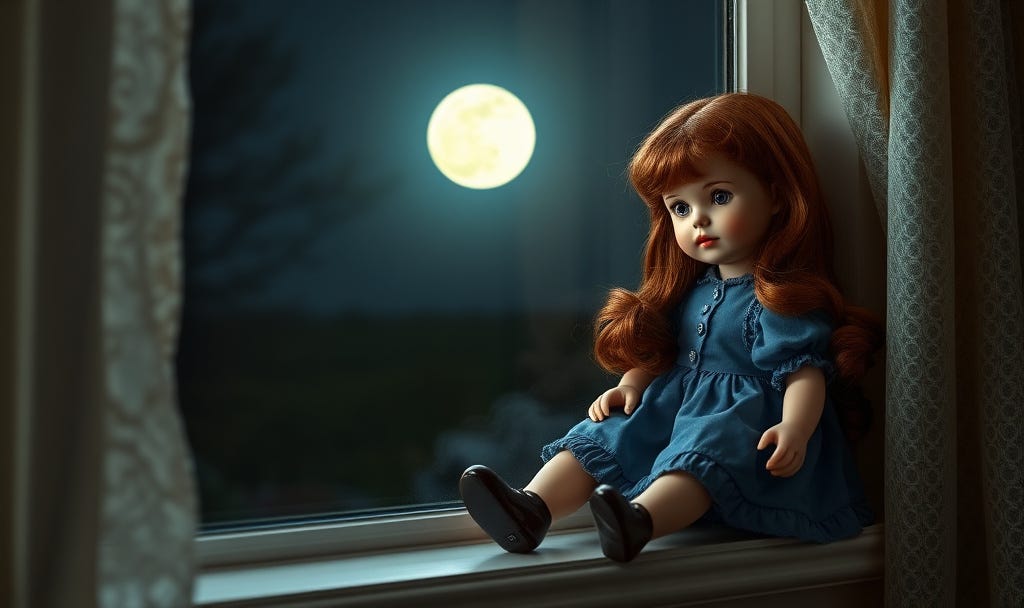
It would be harder to pierce her skin, you tell yourself, if she could still feel. Instead, she stands docilely as you slip the needle into her arm, taking a fluid sample to send to the lab, then introduce the tubes into fixed shunts on the right side of her lower neck, flipping the switch so the pump can change her preservatives for fresh. This is how you love her. This is how much you love her.
She doesn’t blink. Instead of sleeping, she sits at the window every evening, staring out at the stars and the empty backyard.
The other parents in the neighborhood avoid you, steering their children away from your daughter. It wouldn’t kill them to be friendlier. After all, it could be their child they made this decision for, their child who lay in the coffin. Some people had their pets resurrected. How was this different?
There are advantages to resurrection. You never have to think about what to have for dinner; she doesn’t eat, not even her favorites: BLT, chocolate pudding, and animal crackers. All her nutrients are supplied by her preservatives. She’s always quiet. She will never outgrow her clothes. She doesn’t go to school or get into trouble.
Most of the time, she just sits and watches you work, helping when she’s told to, or moving out of the way when necessary.
She never makes a mess. Her clothes are never dirty or torn, and her hair is always perfect, shiny and firm-rooted. It’s a good thing, for any hair that falls out will not grow back, and you were always proud of her hair, its length and smoothness, the volume, the curls that fell out in the rain.
She smells of formaldehyde and something sweet. Like mud. You spray perfume on her, and then she smells like perfume and formaldehyde.
You get used to the smell, for there’s a reason for it. Her veins are filled with a formaldehyde mixture that carries critical nutrients to her cells, revitalizing them with a chemical process the researchers compared to recharging a battery. She will break down one day, they say, but they don’t know how long it will take.
They explain it this way: her cells started to disintegrate as soon as she died. The preservative they ran through her veins three hours and twenty-three minutes later was impregnated with some elements and vital amino acids, and with nanobot-Rs, microscopic self-replicating robots who repair the body one mitochondria, one cell, one ligament at a time. It is experimental. Soon the bots will heal cancer and broken bodies on people who still live, but for now they use them on cadavers. By making a few cell-level chemical changes, they can animate the dead; those changes would kill a living human.
There are perhaps a thousand Susans in the world, all of them the same.
Her daily flush removes toxins and recharge her batteries, all to reinforce the bots in their constant repair work. You envision them as bees in a Susan-hive, each with his own important little task, all those tasks together making up Susan.
She stares blankly across your shoulder as you finish the process and unplug her, allowing you to hug her. She has been seven years old for three years now. She has learned that when you hug her, you want her arms around you, but her hands dangle limply on your spine. Sometimes she frightens you. The changes the bots made hardened her cell walls, reinforcing them with silicon. She has strength beyond that of a normal human adult, though she moves stiffly. Once she lifted the couch for you, when you were vacuuming.
Another funeral. The mother of this child has chosen not to reanimate; you grit your teeth as she whispers to her friends in the PTA about how reanimation creates monsters. The child was a terrible one, wiping snot from its nose every minute, whispering poison in Susan’s ears when you had her out at the grocery store in the beginning, cruel. Susan did not seem to understand the words, but you wonder. After all, children in comas are supposed to be able to hear. How could you stand by and let Susan be hurt by such a vicious child?
The dead child was found under a bridge, where the broken body had washed up on the shore. The sheriff said he must have fallen and hit the rocks somehow before rolling into the water. The wounds on his back and sides are horrible, as if he had been crushed before falling, perhaps by a car. You were part of the search party that found him, you and Susan. The other searchers watched mutely as Susan picked him up out of the water and carried him up the slope to the bridge, a route no adult could have taken, carrying a burden no child could have carried.
She startled everyone, even you, when she picked a daisy and slid it between the child’s fingers.
You chose to come to this funeral with its scent of toxic flowers and sorrow because you felt you had to. Susan sits quietly beside you. The parents surrounding the weeping mother cast glare after glare in your direction, and you pull your daughter closer to you.
It does not take long. Fifteen minutes of the glaring, and you leave. You are not welcome.
Flames awake you that night, the crackling of a wood burning and the smell of hickory and something more pungent. At first you think the house is on fire, but Susan stands mutely in the corner. The bots understand self-preservation, and if the house were in danger she would already have woken you to leave.
The fire isn’t in the house, but on the street. You open your curtains. Someone has built a bonfire in the street, dangling a rag dummy dressed in little girls’ clothes over it to roast. The message is clear.
Susan moves suddenly, stiffly. The resurrectors told you that silicon gradually deposits on her joints, ultimately creating a glass-smooth lubricated stride, but that while it’s depositing it looks much like arthritis, and that’s how Susan is moving, like an old woman with arthritic joints. They are swollen and red, inflamed. She lurches and limps to the window, where she gazes out with you. There are three people feeding the bonfire with toys and a child’s clothes.
One of the people feeding the bonfire turns toward you. It is the mother of the child who died, and when she sees you and Susan, her face twists with hate and rage and impotence.
You recoil and drop the curtain.
The next day you find a real estate agent and set about selling your house. It will be a loss, but you have money, insurance from Susan’s death, from your husband’s. No one in the neighborhood speaks to you, or even looks at you. There is a permanent scorch mark in the street, cracked and blistered asphalt marking where the fire was hottest.
You tell yourself that Susan will love the country, out where you grew up. She has no reaction to most things but indifference. Once you held a flame under her hand. She jerked away, but her expression never changed. The red mark left behind was healed by the bots in less than a day. She is tougher than the scientists thought, superhuman in many ways.
When you pack, she stuffs boxes tirelessly; all you need to do is shape and tape them and tell her what goes into them, and she fills them. Moving furniture, she is more useful than another adult, though you must recharge her twice during the day.
The house you purchased is a huge old Victorian near where you grew up, in need of paint and repairs to the central heat. It has six bedrooms, a parlor, living room, kitchen, fireplaces, basement. Only one bathroom, but Susan doesn’t use bathrooms anymore; her bots process out any waste her body produces. The resurrectors will be upset that you aren’t leaving a forwarding address. They don’t own Susan, or you, and you know how to make the simple preservative yourself. You helped develop it, back before. They will have to find another little girl to lay claim to.
You buy a collie, release it in the backyard, let it run. Susan sees it and laughs for the first time, startling you with its harsh joy. You hug her. This is perfect.
They told you she would never learn, that she would always be the same. Again, they were wrong.
You are washing dishes in the summer, scrubbing your plate, fork, and cup clean. It is rare that you eat more than a TV dinner, but it being summer, you have a cookout. Susan is playing with the dog, who has been named Shamrock. He’s a beautiful creature, long-haired, long-snouted, long-tailed, and after getting used to her odor, he has grown fond of Susan. Perhaps because you make sure she’s the one who feeds him.
They are romping in the yard outside, Shamrock jumping on Susan to knock her over. She laughs, laughs. A child’s laughter is a beautiful thing, and you stop to watch.
She hugs the collie, scruffles his fur, kisses him on the nose.
They said she would never do any of these things. You stand and watch, just watch, for an hour, two, as your child plays with her pet.
Later, when you say goodnight, Susan throws her arms around her and kisses you.
Your tears soak the pillow that night.
A week later, Susan comes to you and kneels next to your chair. Her lips press together as she stares intently at you. “M-m-m-m-- “ She takes a deep breath. Her voice, when it comes out, is husky and different, but unmistakably Susan’s.
“Mom - I - love - you.”
You contact the resurrectors for the first time in months after that, calling from a burner phone fifty miles from home. They are excited, say it’s a miracle. No, they respond to your question, Susan is the first one to show any signs of human intelligence. Or speech. What are you doing differently? How are you changing things?
You hang up the phone without responding. She’s not like the others, then. For the first time, you consider enrolling her in school again. She could play with the other children. Interact with other adults. Perhaps, with more stimulation, she could become more normal, more like she was before she died.
So in September, you enroll her. It’s a little country school surrounded by bushes and banks of perennial flowers, a tall flagpole flying a slightly-tattered flag, children everywhere laughing, tossing squishy balls, playing with their phones.
Susan hangs back, showing shyness for the first time since she died. You have braided her auburn hair down her back, two cute pigtails; it hasn’t grown at all, and regular hot-oil treatments have kept it in good shape. It’s darker in color than you remembered. Her pristine blue dress skims her knees, and a little cleverly-placed makeup hides the permanent hollows under her eyes; that delicate tissue is slow to repair. She holds your hand, not speaking a word, though by now her vocabulary is extensive, more even than when she was alive. She reads everything she can, though she needs a magnifying glass because her corneas can no longer focus properly, and she retains it all.
The school is not sympathetic. “Mrs. Jones, I’m certain your child is bright. But the fact is, she’s special needs. I’m afraid we aren’t set up for children like -- her.”
“What do you mean, like her?”
“Ma’am, it’s obvious to me at least that the child is, um, not normal.”
You feel a thrill of panic. “How did you know?”
“It’s quite obvious.”
“No, it’s not.”
“Be that as it may, Mrs. Jones. We cannot enroll --” he glanced at her enrollment forms, “Susan at this time. We can help you get her into Swift Academy in Rochester if you like. I apologize.”
You snatch the papers away and leave. Susan is not where you left her, out in the hall. A surge of adrenaline thrills up your spine. You drop the paperwork where you stand and call, “Susan?”
No answer.
Your hands are shaking, your knees. Your eyes aren’t focusing properly, and there is a roaring in your ears. It’s like losing her to death again. You run down the hall, calling for her. Teachers and students look out doors at you, you indiscriminately shove children out of your way. A couple start crying. They are immaterial. You must find Susan.
And down a hall, surrounded by the fading sound of giggling girls, there she is, crouched with her side to you, arms covering her books. “Susan!”
She looks up, cries in her blurry voice, “Mom!”
You stare in horror at the blackened, glistening wound where her left braid used to be. The other girls have pulled it out.
You stitch up the wound and clean it with iodine, then formaldehyde. The bots do what they can, but they can’t regrow hair follicles or patches of skin, and the children took the braid with them. What isn’t here cannot be reattached. It will have to be a wig now.
This cannot be borne. Your child clings to you all night, lying next to you in bed as you try to sleep; this night you don’t sleep any more than she does. But she seems comforted in the morning, looks out the window, plays with the dog.
You don’t try to send her to school again.
You start baking cookies. You let the dog out in the front yard. You place toys temptingly close to the street. Susan remains indoors or goes out in the backyard. And although your house is well away from other homes, set back in the trees, children start coming near your house, timidly at first, then more boldly as you offer them cookies. You never let them in the yard or house, and you always take care that their parents are aware, asking the children who their mothers and fathers are, calling them to protest that one never knows, making them your friend. Eventually, you choose one. And you never, never pick a child that you’ve seen in the last month.
You scout the wooded hills nearby, at last finding the cave you remember from your childhood. It costs money. You have money. It takes time. You have time, too.
Soon the newspapers begin talking about the missing children. You don’t care. You know where they are. And they will be fine.
Just as soon as the bots take root, Susan will have playmates again.